Feature
Why Puzzle Games Feel So Good
Puzzle games are among the simplest things you can play and among the hardest to stop playing. The reasons are mostly design, and they are worth understanding.

There is a specific feeling that a good puzzle produces. Not excitement exactly, and not relaxation either: something closer to absorption, where twenty minutes disappear and you look up mildly surprised. Puzzle games chase that feeling more directly than almost any other genre, and when they get it right the result is out of all proportion to how simple the game is.
It is worth being upfront about what follows: these are observations about game design, not claims about neuroscience. Plenty of writing on this subject reaches for brain chemistry it cannot support. The design patterns below are real, consistent and observable in the games themselves, which is a more useful thing to understand anyway.
Difficulty you can actually see the edge of
The most-cited idea about absorbing activities is flow: the state where challenge and ability are closely matched, and attention narrows to the task. Too easy and you are bored; too hard and you are anxious. What is interesting about puzzles is not that they achieve this, but *how cheaply* they do.
A puzzle can adjust difficulty precisely, instantly, and without narrative cost. Sudoku has four difficulty levels and moving between them is a menu choice. A jigsaw goes from six pieces to twelve hundred with a slider. No other genre can re-tune itself to your exact ability that granularly, and that is why puzzles hold such a wide range of people at once.
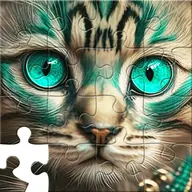 Favorite Puzzles6 pieces to 1,200: the same game for a four-year-old and a serious puzzler.Play
Closure, and the pull of the unfinished
A partially solved puzzle is uncomfortable in a way a partially watched film is not. There is a well-known observation in psychology (usually called the Zeigarnik effect) that unfinished tasks stay more present in memory than completed ones. Whatever the mechanism, the experience is familiar: the half-sorted board is genuinely harder to walk away from than the finished one.
Puzzle games lean on this constantly, and mostly honestly. A Sudoku grid with four cells left is not manipulating you with a timer or a streak counter. It is just visibly incomplete, and completeness is the entire point of the object. The pull comes from the puzzle's own structure rather than from a system bolted on to retain you.
Feedback with no ambiguity
In most games it is unclear whether you played well. You won the fight, but was that skill or the enemy AI being generous? Puzzles have no such fog. The tiles matched or they did not. The nuts are sorted or they are not.
That clarity is rarer than it sounds, and it is a large part of why puzzles are restful even when they are difficult. There is no interpretation required and no social judgement involved. The feedback is immediate, unambiguous and entirely private. For a lot of people that is precisely the relief on offer after a day of tasks where none of those things are true.
A world with a defined edge
A standard Sudoku grid has 81 cells. A particular mahjong board or jigsaw has a fixed set of pieces to clear or place. An individual puzzle can offer a clear objective even when the surrounding game keeps generating new boards.
That visible objective can make progress easier to judge than in an open-ended activity. Difficulty and solvability vary between puzzles, and some games offer endless runs or new levels. Choose a format with stopping points that suit the time and effort you want to spend.
The satisfying shape of a cascade
The best moment in most puzzles is not the solution but the cascade just before it: the point where one placement forces the next, which forces the next, and a position you had been grinding at unravels in fifteen seconds.
This is the payoff for effort that felt unproductive at the time, and it is why puzzle difficulty curves are shaped the way they are. Good puzzle designers deliberately build toward that unravelling: the tension of the stuck period is what makes the cascade feel earned. Games that make progress smooth throughout are less satisfying, not more.
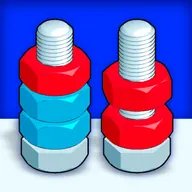 Nuts Puzzle: Sort By ColorA colour-sorting puzzle built almost entirely around the cascade moment.Play
The case for the ones with no challenge at all
Not every puzzle is trying to be difficult, and it is worth defending the ones that are not. Colour-by-number has no failure state and no meaningful decisions: you pick a colour and fill in the areas carrying its number. By any conventional measure it is barely a game.
It is also genuinely useful. There are moods in which being challenged is the opposite of what you want, and an activity offering visible progress, low-stakes focus and a clear rhythm is worth having available. A puzzle catalogue with nothing in it for a bad day is missing something real.
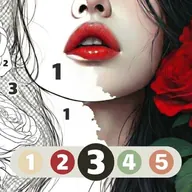 NumicolorNo timer, no failure state: the one to play when you want none of the above.Play
What this suggests about choosing games
If the appeal is really about matched difficulty, clean feedback and bounded scope, then a few practical things follow:
- Match the game to the mood, not to your ability. Playing Expert Sudoku when you want to switch off is a category error, and so is colouring when you want to be tested.
- Prefer games that let you stop. Level-based puzzles with clean breakpoints respect your time in a way endless-run formats often do not.
- Be suspicious of pressure that is not the puzzle. Timers, energy meters and streaks are retention mechanics, not difficulty. They rarely make a puzzle better.
- Change genre rather than difficulty when bored. Moving from tile-matching to word grids restores novelty far more effectively than turning the same puzzle up a notch.
None of which is complicated. But it does explain why a twenty-year-old format with no graphics budget can still be the most absorbing thing you do all evening.
Games mentioned in this guide
 Match & Sort
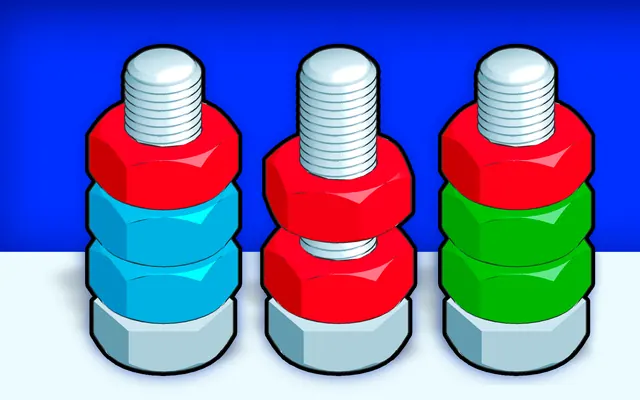
Nuts Puzzle: Sort By Color
Sort coloured nuts onto bolts until every screw holds a single colour.
Phone + desktop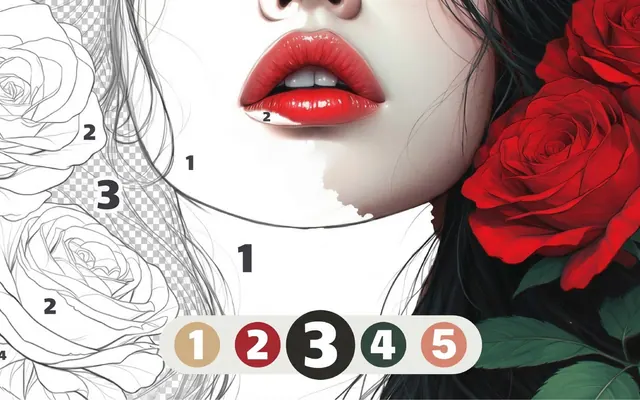 Word & Number
Numicolor
Colour by number: a quiet, methodical way to switch off.
Phone + desktop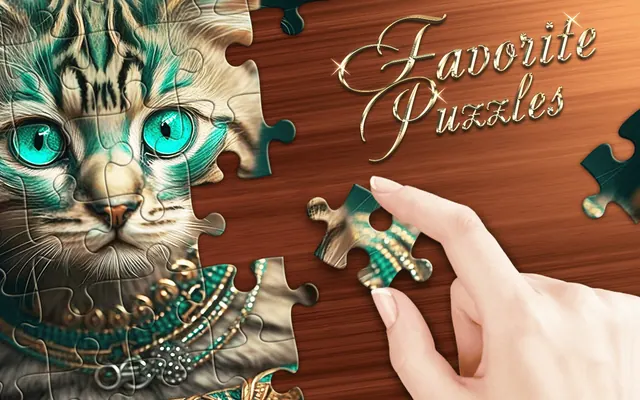 Logic & Classics
Favorite Puzzles
Jigsaws from 6 pieces to 1,200: including ones made from your own photos.
Phone + desktop


