Strategy
How to Get Better at Hidden Object Games
Finding things quickly is a trainable skill, not a talent. Here is what actually improves your search speed, and why staring harder is the worst possible strategy.

Hidden object games are usually described as relaxing, which is true, and as simple, which is not. Anyone who has spent four minutes failing to find a thimble that turned out to be in the middle of the screen knows there is a skill here. The encouraging part is that it is a very learnable one.
Visual search has been studied for a long time, and the useful conclusion for players is this: your eye is not a scanner. It jumps between points of interest in a pattern shaped by contrast, colour and expectation. Left to itself it will revisit the same salient corner repeatedly while never fixating on the dull region where the object actually is. Getting better means overriding that.
Scan systematically, not intuitively
The single highest-value habit is imposing a fixed pattern on your search. Left to right, top to bottom, in bands. The same way you would read. It feels slower than free-scanning. It is not, because free-scanning covers roughly 60% of a scene while feeling like it covered all of it.
Systematic scanning also gives you something free-scanning never does: certainty. When you have swept a band properly you can rule it out, and the search space genuinely shrinks. Otherwise you are searching a scene that feels infinite because you never finish anywhere.
Colour camouflage beats size every time
The instinct is that hidden objects are hidden by being *small*. Mostly they are hidden by being the same colour as what is behind them. A brass key on a brass doorplate, a red ribbon on a red cushion, a wooden spoon against a wooden table.
The counter is to stop looking for objects and start looking for edges. A camouflaged object still has an outline that interrupts the texture behind it. Scanning for discontinuity rather than for shape finds colour-matched objects far faster.
Watch for scale confusion
Once you have been hunting for small items for a few minutes, your brain quietly narrows its search to small items. Designers know this. The listed "book" is a wall-sized poster of a book; the "key" is part of the wallpaper pattern; the "moon" is the actual moon in the sky.
The fix is mechanical: every minute or so, zoom fully out and look at the scene as a whole. Large objects are invisible at high zoom, and they are exactly what you have trained yourself to skip.
 Hidden Object: Street Of SecretsWide detective scenes with real pan-and-zoom navigation.Play
Re-read the item name
A surprising share of stuck moments are not search failures but comprehension failures. You are looking for a "pitcher" and scanning for a jug when the scene contains a picture. Or the scene has three plausible candidates and only one is the listed sort.
When an object refuses to appear after a proper sweep, re-read its name and say it out loud. It resolves the problem more often than continuing to look does.
Object blindness is real, take the break
Stare at a scene long enough and you stop seeing it. Your eye keeps moving but fixation stops registering, which is why you can look directly at the object you need and not see it: then spot it instantly ten seconds later.
The remedy is a genuine reset: look away from the screen entirely for twenty or thirty seconds. Not a pause, not a zoom: look at something else. This is more effective than another two minutes of searching, and it is the technique experienced players use most and beginners use least.
Spend hints at the right moment
Hints are almost always spent too early, on the first object that resists. Think about it in terms of search area instead. Early in a scene you have a dozen objects to find and the whole scene to find them in, so any given sweep is productive. At the end, with one object left, you are re-searching the entire scene for a single item: the worst possible ratio of effort to reward.
Save hints for the last one or two items. That is where they buy the most time and cost the least satisfaction.
Use found objects as a map
In games where found objects stay marked: Find the Frog is the clearest example, since found frogs stay in colour against a black-and-white scene. Those markers are a coverage map. Regions with no markers are either genuinely empty or unsearched, and it is worth knowing which.
 Find the Frog - Hidden ObjectsMonochrome scenes where found frogs burst into colour, a natural coverage map.Play
A short practice routine
If you want to actively improve rather than just play, try this for a few scenes:
- Read the entire item list before looking at the scene. Load the shapes into memory first.
- Sweep in bands, left to right, top to bottom. Finish each band before moving on.
- On the second pass, scan only for interrupted edges and texture breaks, ignoring colour.
- Zoom fully out once before you consider yourself stuck.
- Look away for twenty seconds before spending a hint.
Most people find their completion time drops noticeably within a handful of scenes. Not because their eyesight improved, but because they stopped letting their attention wander and called it searching.
Games mentioned in this guide
 Hidden Object
Hidden Object: Street Of Secrets
A detective story told entirely through the things people leave behind.
Phone + desktop Hidden Object
Hidden Object: My Hotel
Restore a run-down hotel one cluttered room at a time.
Phone + desktop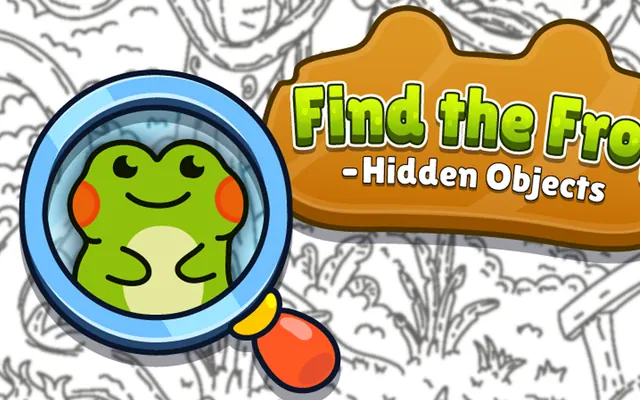 Hidden Object
Find the Frog - Hidden Objects
Monochrome worlds where the only splash of colour is the frog you have not found yet.
Phone + desktop


