Strategy
How to Solve Sudoku: From Your First Scan to Expert Technique
Most people learn Sudoku by staring at the grid until a number appears. There is a much faster way, and it is entirely teachable. Here are the techniques that take you from Easy to Expert, in the order you should learn them.

Sudoku has exactly one rule: fill the 9×9 grid so every row, every column and every 3×3 box contains the digits 1 to 9 once each. That is the whole game. Everything else (every technique in this guide) is a consequence of that single constraint.
Which is why the most common way people play Sudoku is also the least effective. Scanning the grid hoping a number will announce itself works on Easy puzzles and collapses immediately on Hard ones. What actually works is a small set of named techniques, applied in a deliberate order. You can learn the first two in about five minutes and they will carry you through most Medium puzzles.
Technique 1: Naked singles
A naked single is a cell where only one digit is possible. Look at an empty cell, check its row, its column and its 3×3 box, and list which digits are already taken. If eight of the nine are accounted for, the ninth goes in that cell.
This is the technique everyone discovers on their own. The refinement most people miss is *where to look*. Do not scan cells at random: go to the cells with the most filled neighbours. A cell in a nearly-complete box, sitting in a nearly-complete row, is where naked singles live. Scanning the emptiest part of the grid is wasted effort.
Technique 2: Hidden singles
A hidden single is the same idea viewed from the opposite direction. Instead of asking "what can go in this cell?", you ask "where can this digit go in this unit?": where a unit means one row, one column or one box.
Pick a box. Ask where the 7 can go. If seven of the nine cells are excluded (because a 7 already exists in their row or column) and one of the remaining two is filled, then the 7 must go in the single cell left. That cell might have four or five theoretically possible digits, which is why the single is "hidden": you would never have found it by looking at the cell in isolation.
Hidden singles are the single biggest jump in solving ability most players make. Between naked and hidden singles you can finish nearly every Easy and Medium puzzle without ever writing a pencil mark.
 Sudoku OnlineFour difficulty levels plus X-Sudoku, Windoku, Killer and Kropki variants.Play
Technique 3: Use pencil marks properly
From Hard upwards, singles run out. This is where notes mode stops being optional. Pencil marks (writing every candidate digit into a cell) are not a crutch; they are the working memory that advanced techniques operate on. You physically cannot see a naked pair without them.
Two habits make pencil marks useful rather than overwhelming:
- Fill them in completely, once. Partial notes are worse than none, because you will trust them and they will be wrong.
- Update immediately after every placement. The instant you write a 4 into a cell, strike 4 from every candidate list in that row, column and box. Techniques only work on accurate notes.
Technique 4: Naked pairs and triples
Here is where Sudoku starts to feel clever. If two cells in the same unit both have exactly the candidates {3,7} (and only those two) then between them they will consume the 3 and the 7. You do not know which goes where, and it does not matter. What matters is that no other cell in that unit can be a 3 or a 7, so you can strike those candidates everywhere else in the unit.
The same reasoning extends to three cells sharing three candidates (a naked triple) and four sharing four. Triples are worth learning; quads are rare enough that you can safely ignore them until they become the only move left.
Technique 5: Pointing pairs
This one exploits the overlap between boxes and lines. Suppose within one 3×3 box, the only cells that could hold a 5 both sit in the same row. You do not know which of the two it is, but you know the 5 for that box is somewhere in that row. Therefore the 5 cannot appear anywhere else in that row, including in the two other boxes the row passes through.
Pointing pairs are what break open most Hard puzzles. They are the first technique that transmits information *between* units rather than reasoning inside one, and once you start seeing them the grid feels much less rigid.
What to do when you are stuck
Being stuck in Sudoku is almost always one of three things, in descending order of likelihood:
- You stopped scanning too early. Go back to hidden singles and check all 27 units (nine rows, nine columns, nine boxes) systematically. People check maybe twelve and conclude there is nothing.
- Your pencil marks are stale. One missed elimination poisons everything downstream. If a puzzle feels impossible, re-derive the candidates for the unit you are working in from scratch.
- You made an error earlier. If you have a duplicate digit in any unit, everything after that point is fiction. Scan each row, column and box for repeats before assuming the puzzle is hard.
Notice that none of these is "the puzzle is too difficult". On a well-generated grid, the deduction is always there.
Where to go after classic Sudoku
Once Expert puzzles stop resisting, the interesting move is sideways rather than harder. Variants change which constraints exist, which forces you to rebuild your intuition rather than just apply the same techniques faster:
- X-Sudoku adds both main diagonals as units. Two extra constraints, and they cut across boxes in a way that creates deductions classic Sudoku cannot.
- Windoku overlays four additional hidden regions, so many cells belong to four units instead of three.
- Killer Sudoku replaces starting clues with cages that must sum to a total, which brings arithmetic into what was pure logic.
- Kropki marks adjacent cells that are consecutive or in a 2:1 ratio, turning the relationships between cells into the primary information source.
Killer is the most different of the four and probably the best next step. It rewards exactly the constraint-narrowing instinct classic Sudoku builds, while asking you to apply it to sums rather than positions.
If you would rather stay in pure deduction territory, Arrow Exit Puzzle scratches a similar itch with completely different mechanics: a sequencing problem where the challenge is working out the order in which pieces can be removed.
Games mentioned in this guide
 Word & Number
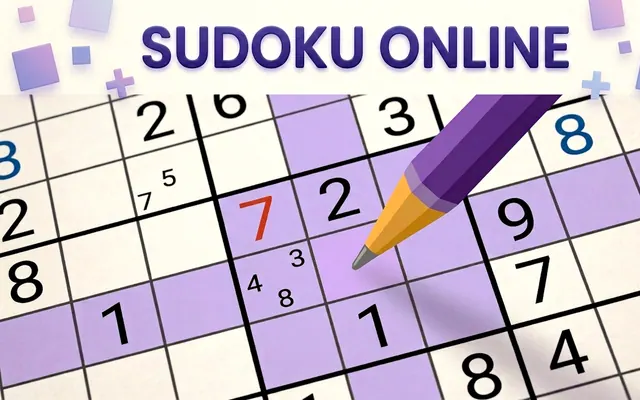
Sudoku Online
Four difficulties, four rule variants, and every puzzle solvable by pure logic.
Phone + desktop Word & Number
Numicolor
Colour by number: a quiet, methodical way to switch off.
Phone + desktop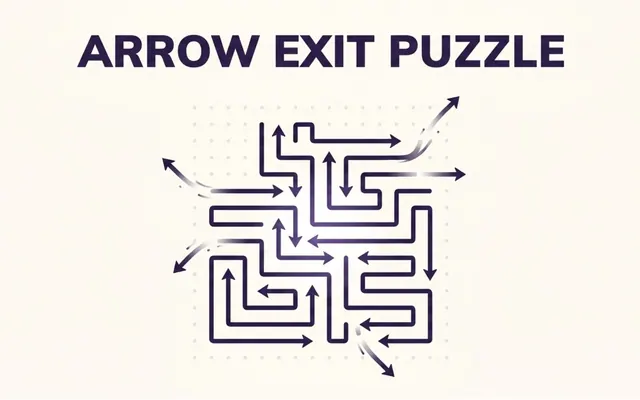 Logic & Classics
Arrow Exit Puzzle
Every arrow has an exit. Find the order that lets them all leave.
Phone + desktop


